Steer Health
Product design for an AI patient-capture and revenue platform in healthcare
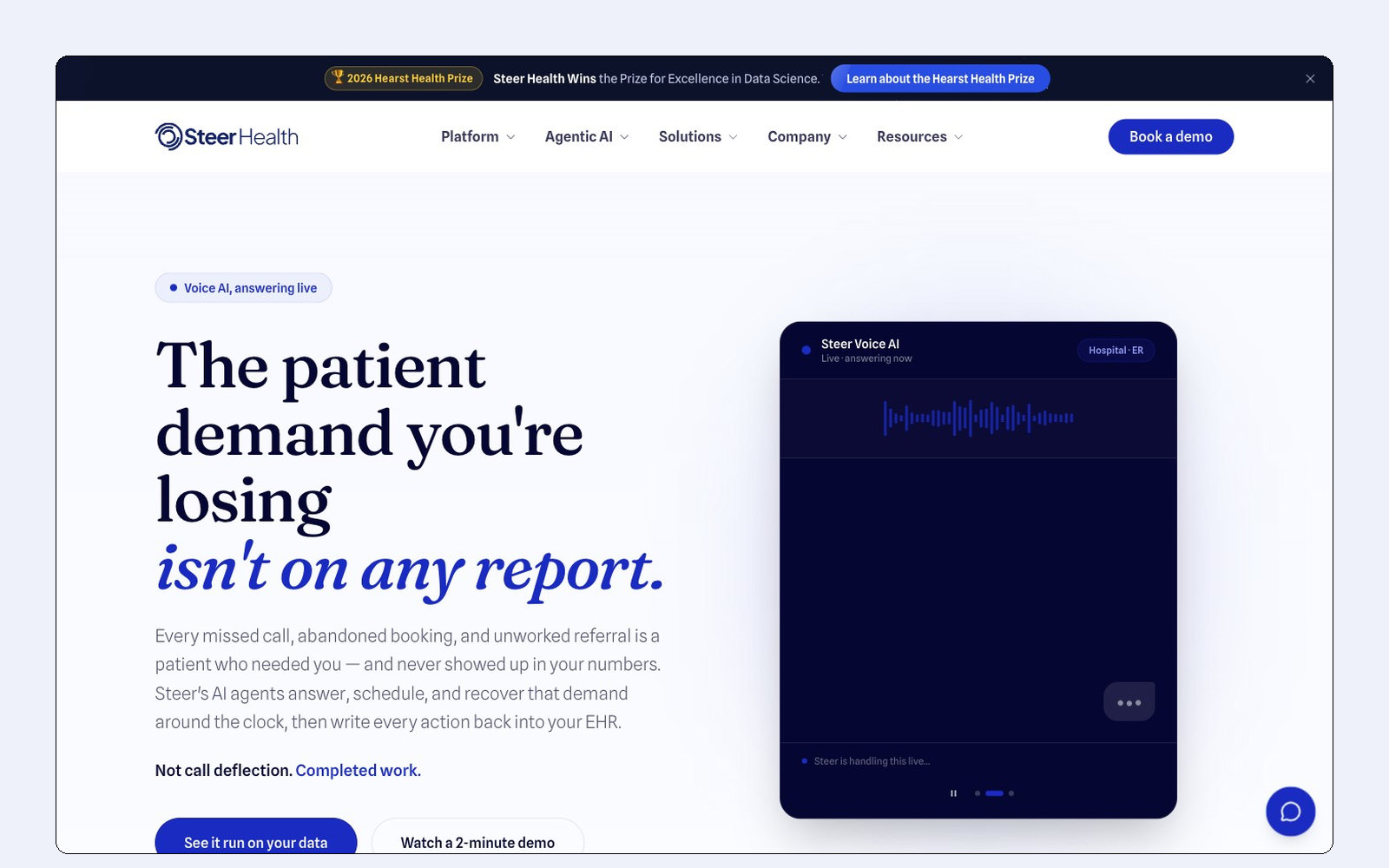
Steer Health runs the patient journey for hospitals and specialty practices — inbound demand, scheduling, insurance verification, collections, recall and care-gap closure — with a set of AI agents doing the work and writing every action back into the EHR. It’s live across 109 organisations and 472 locations.
I was senior product designer on it.
The positioning problem, which is a design problem
Healthcare has been sold “AI that answers the phone” for years, and buyers have learned to discount it. The distinction the whole product rests on is not call deflection — completed work: the agent doesn’t route the caller, it books the appointment, checks the eligibility, and files the result.
That line only lands if the interface proves it. So the surfaces are built around outcomes rather than activity: what was captured, what was booked, what was recovered, and where it landed in the EHR. An agent screen that shows conversation volume is describing effort. One that shows recovered revenue is describing work.
What that means on screen
- Live agent state — a voice call in progress reads as live, answering now, with a waveform and a running transcript. Nothing about an autonomous system should require the user to guess whether it’s currently doing something.
- The seven agents as a legible set, each with its own remit across capture, scheduling, revenue and retention — so the platform reads as a staffed function rather than a feature list.
- Write-back as a first-class state. The end of every flow is a record in the customer’s own system. Showing that step is what separates a demo from an operations tool.
In this engagement 7
-
 Marketing site The public site for a healthcare platform selling a claim, not a spec sheet 2026
 - Kiosk The check-in kiosk product, for practices running patients through the front desk 2023 — 2026
- AI health app Biomarker data in, analysis back a week later 2023 — 2026
- ASC solutions Software solutions for ambulatory surgery centres 2023 — 2026
- Scheduling The scheduling system underneath the patient journey 2023 — 2026
- Luna The AI chatbot patients actually talk to 2023 — 2026
- Events & print Booths, print material and the offline side of the brand 2023 — 2026