Flick Fire
A custom Shopify theme for an Indian esports hardware brand
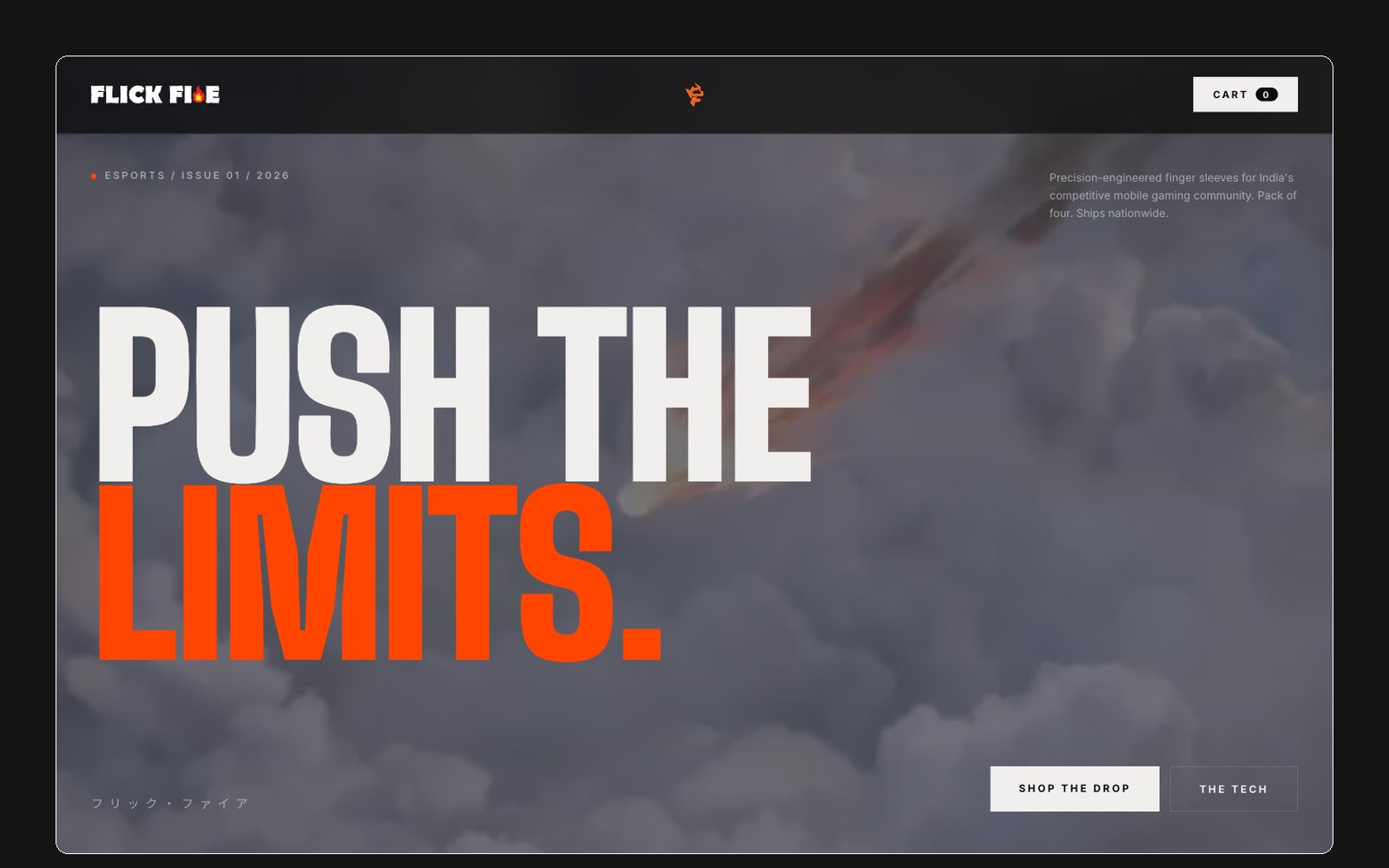
Flick Fire sells precision finger sleeves to India’s competitive mobile gaming community. The audience is teenagers and twenty-somethings who play Free Fire and BGMI on a phone, follow esports orgs, and can tell the difference between a brand that plays games and a brand that has read about them.
So the store is not built like a store. It’s built like a drop.
The direction
A 100 Thieves–style editorial treatment: dark canvas, oversized condensed display type,
one accent, no gradients, no rounded friendliness. PUSH THE LIMITS. set at a size that
breaks the grid, half of it in orange. An issue line — ESPORTS / ISSUE 01 / 2026 —
because streetwear drops are numbered and this category borrows from streetwear, not from
peripherals retail.
Katakana in the bottom corner, a scrolling marquee, and product cards that read as editorial spreads rather than tiles with a price under them.
Built as a real Online Store 2.0 theme
Not a page builder and not a bought theme with the colours changed — a custom theme
written from theme.liquid up, so every section is editable in the Shopify theme editor
by whoever runs the store next.
| Templates | JSON templates for index, product, collection, list-collections, cart, page, search, 404 |
| Sections | Pinned header and footer groups, plus hero, marquee, featured products, features grid, and a manifesto/stats block |
| Snippets | One editorial product-card reused across home, collection and search, so the card can never drift between pages |
| Assets | Hand-written theme.css and a small theme.js for reveal-on-scroll and AJAX add-to-cart |
The homepage’s featured products pull real product records through picker blocks rather
than being hardcoded, and settings expose the brand name as two halves (FLICK / FIRE)
so the split-colour lockup stays editable instead of being baked into markup.
Why AJAX add-to-cart mattered here
The traffic is almost entirely mobile, on Indian networks, and the product is an impulse buy at a low price point. A full page reload between “I want this” and “it’s in the cart” is where that impulse goes to die. Adding to cart never leaves the page.